Multiplication chart 1–50
Every product from 1 × 1 to 50 × 50 on four tiled pages or one 24-inch poster: 2,500 answers. This 50x50 multiplication chart, also called a multiplication table, is a free PDF in Letter or A4.
four pages, or one posterUpdated
- Grid
- 50 × 50
- Products
- 2,500
- Largest product
- 2,500
- Squares on the diagonal
- 50
- Different numbers
- 800
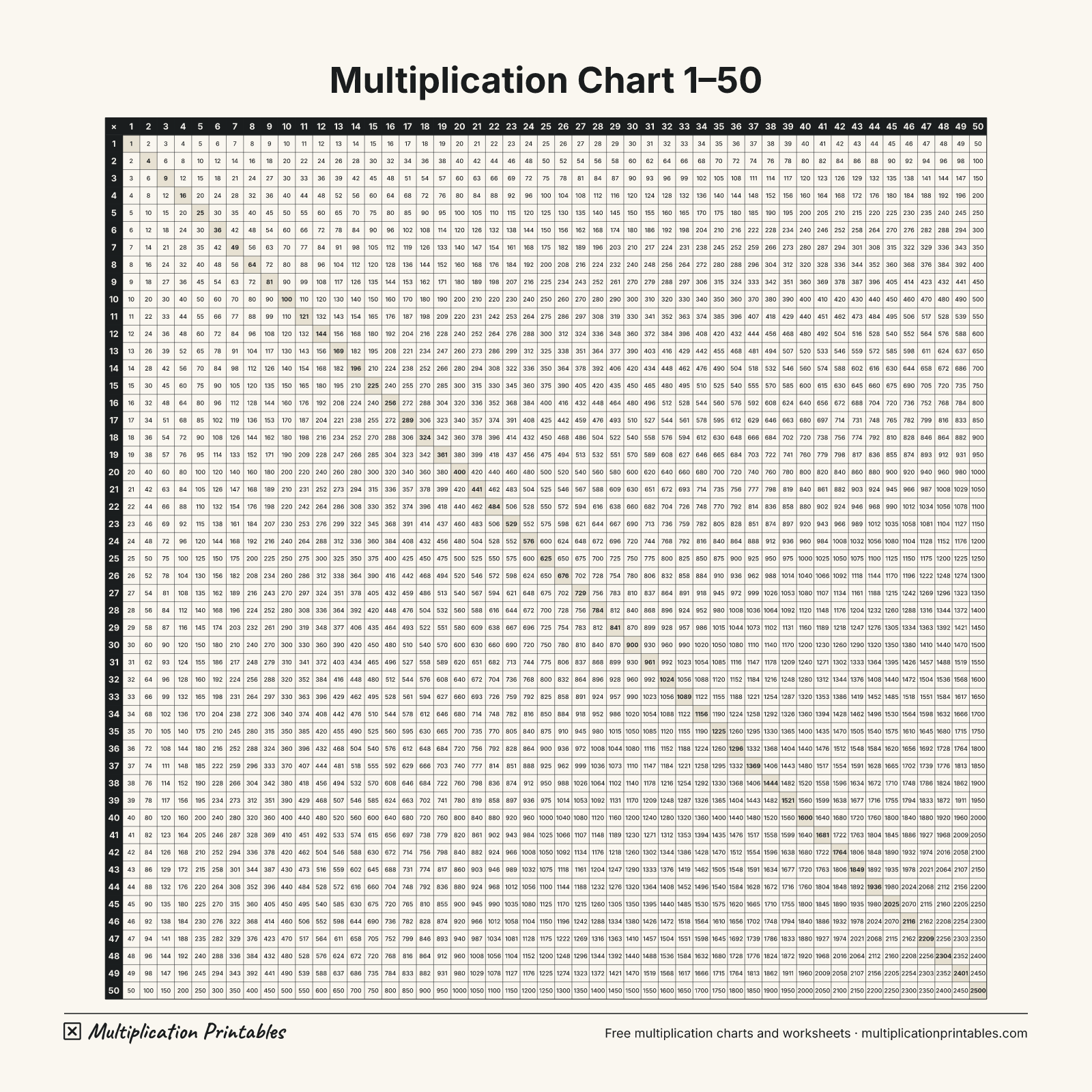
The PDF splits the chart into 4 pages of 25 rows by 25 columns, each with its own header row and column, to tape together. The poster file is one 24 × 24 in page for a print shop.
Patterns in the 1–50 chart
The diagonal of squares
From the top left to the bottom right the chart reads 1, 4, 9, 16 and on to 2,500. The steps between them are the odd numbers: 3, 5, 7, 9.
44 × 44 = 1,936 · 47 × 47 = 2,209 · 50 × 50 = 2,500Two halves that match
The chart is a mirror across the diagonal, because 7 × 47 and 47 × 7 are the same. That leaves 1,275 facts to learn, not 2,500.
1,225 mirrored pairs + 50 squares = 1,275The numbers that repeat
Only 800 different numbers fill the 2,500 squares. None appears more than twelve times; 120, 180, 240 and one more do.
120 = 3 × 40 · 4 × 30 · 5 × 24 · 6 × 20 · 8 × 15 · 10 × 12The 50s row
To multiply by 50, halve the number and add two zeros. Row 50 is half of row 100 all the way across.
50 × 36 = 18 and two zeros = 1,800
Other multiplication charts
Multiplication chart 1–50 FAQ
How many facts are on a 1–50 multiplication chart?
2,500, one for each square of the 50 × 50 grid. Because the order of the two numbers does not matter, 1,275 of them are different facts.
What is the biggest number on the chart?
2,500, in the bottom right corner, from 50 × 50.
Does it fit on one page?
Not at a readable size. The PDF splits the chart into four pages of 25 rows by 25 columns that tape together, and there is a single-page 24 × 24 inch poster file for a print shop.
How do I read it?
Find the first number down the left side and the second along the top. The square where that row and column meet holds the answer.